
Employee Benefits and Perks in Game Studios: 21 Top Types
Read
In the Gamedev Salary Pulse 2026 benefits data, the four-day workweek it’s the single most desired benefit among respondents, yet it’s still rarely offered by studios.
That gap is the story and we will take a deeper look into it. But the conclusion is not “every game studio should switch to the four-day workweek next month.”
The realistic conclusion is that game developers want time-based resilience more than lifestyle perks, and the four-day workweek has become the clearest symbol of that shift.
In this article, you’ll learn how to use the Gamedev Salary Pulse report data to adjust your company’s benefits policy to 2026 realities (without necessarily increasing your budget). It’s a practical read for People Officers and Human Resources Officers not only in gamedev, but across the wider tech world, and for decision-makers such as team leads, managers, and board members who shape how work actually feels day to day.
Before we start, a quick note for readers outside gamedev: the games industry has been in real turmoil, with repeated waves of layoffs and restructures. Keep that context in mind as we talk about benefits – this isn’t a “must-have perks” fantasy world, but a discussion about what helps teams stay resilient when the market is unpredictable.
Before we unpack the numbers, a quick note on where they come from – Gamedev Salary Pulse by 8Bit is our annual, survey-based snapshot of the video games industry job market. We collect anonymous responses from game professionals across regions and disciplines, then publish the results for free, as a practical report for studios and talent teams to benchmark against.
For the benefits section, we deliberately ask two separate questions:
1. what benefits your employer offers,
and
2. which three benefits you have or wish you had that would really make a difference.
That second question is the important one. It forces prioritization and helps separate “nice-to-have” perks from benefits that actually impact daily life.
In the 2026 “make a difference” list, the four-day workweek ranks #1 at 38.5%. Yet only 4.2% report their employer offers it:
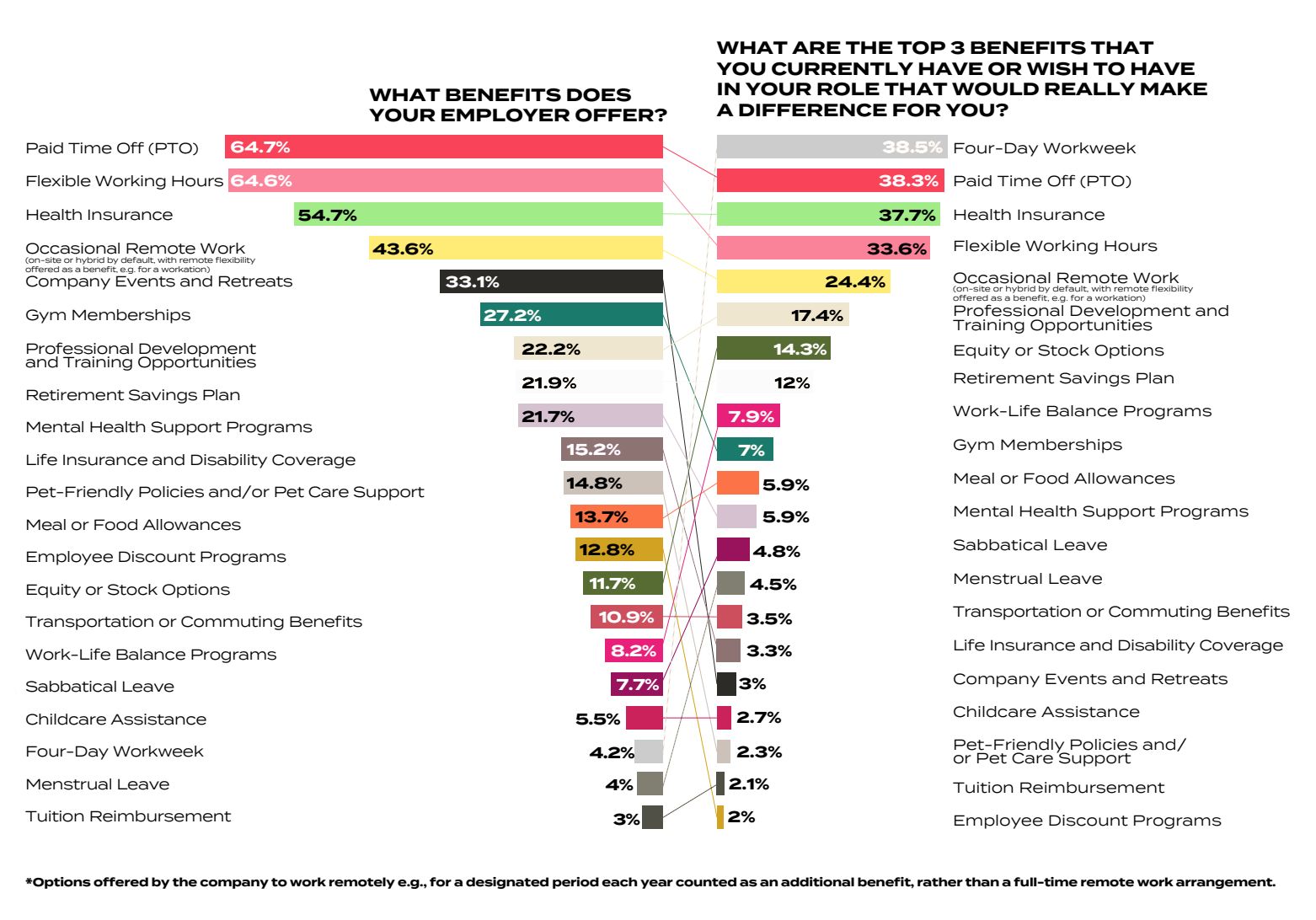
This is not a small mismatch. It’s a structural signal that developers prioritize recovery and control over time far more than many traditional perk strategies assume.
This question isn’t unique to games. Across software, product, and other tech-heavy industries, the same tension shows up: teams love the idea of fewer working days, but the operating model often isn’t designed for it.
In practice, four-day workweeks tend to work best in environments where work can be intentionally de-scoped, meetings reduced, and delivery pipelines are mature enough to prevent constant fire-fighting. Industries with heavy support rotations, customer incident response, or tightly coupled cross-team dependencies often need more redesign before fewer days become realistic.
Gamedev has its own version of these constraints, often amplified by production milestones, creative iteration, and release pressure. So the same caution applies, just… louder.
Gamedev isn’t a uniform production environment. Small teams, milestone-driven schedules, publisher deliveries, and live ops cadence can make a full four-day workweek switch risky.
If workload stays the same, a four-day week can turn into “five days compressed into four,” which increases stress and defeats the purpose. Some studios also run multi-time-zone operations. Reducing overlap hours can create new bottlenecks if collaboration is heavy.
So yes, it’s highly possible that for a large portion of the industry, a formal four-day workweek will remain an exception rather than the default.
If you’re reading this as a lead, a manager, or someone on the board, here’s the honest version: you don’t need to “buy” a four-day workweek to respond to what people are telling you, but try treating it as a signal.
Your team is asking for time recovery, predictability, and a sustainable pace – especially in a gamedev market that’s been shaken by layoffs, restructures, and constant uncertainty. So the real question becomes: what can you change that gives time back without breaking delivery?
Start with the unglamorous stuff. Reduce meeting load, protect focus time, and put guardrails around off-hours so people can actually recover.
Micro-example: if you can’t reduce total hours, you can still introduce protected focus blocks (no-meeting half-days) and perhaps add quarterly recovery days (extra time off) aligned to delivery cycles.
Your goal is to make work feel sustainable in your specific operating model.
Some benefits are increasingly treated as baseline expectations, so they don’t automatically make you stand out.
In practice, that “expected” set usually includes things like reasonable PTO, some level of schedule flexibility, and a work model that matches reality (clear rules for remote, hybrid, or on-site). In many locations, health coverage also lands in the baseline bucket, either because it’s publicly provided, or because employer-linked healthcare makes it non-negotiable.
In the 2026 dataset, PTO and flexible working hours are widely offered (PTO 64.7%, flexible hours 64.6%). They also remain highly valued as “difference makers” (PTO 38.3%, flexible hours 33.6%).
Here’s the simplest way to read this part of the data:
Lifestyle perks often look good externally, but they don’t change the lived reality of work.
In the 2026 data, company events and retreats are offered by 33.1% of employers, yet only 3% rate them as a top-three benefit that would really make a difference.
Gym memberships are offered by 27.2% of employers, while only 7% list them as highly valuable.
In turbulent market conditions, people prioritize stability and recovery over occasional “peaks.”
A practical tip before you cut or double down on any perk: check usage rates. Your benefits providers (gym networks, EAP/mental health vendors, insurance brokers, learning platforms) should be able to share participation data. If a perk is heavily advertised but rarely used, that’s a strong signal the budget might be better spent elsewhere.
As we already said, a shorter workweek may not be for everyone. But for studios and companies willing to try, the good news is that we don’t have to guess in the dark—there are real pilots with measurable outcomes.
One of the most referenced examples is the UK’s large-scale four-day week trial (June–December 2022), involving 61 companies and around 2,900 workers. The model wasn’t “one-size-fits-all”, organizations designed different versions of reduced hours while keeping pay at 100% and ensuring a meaningful reduction in time. At the end of the pilot, 92% of participating companies continued with the four-day week, and broader summaries from the same ecosystem highlight employee outcomes such as lower stress and reduced sick leave.
Iceland is another frequently cited case. Government-run trials between 2015–2019 tested 35–36 hour weeks with 2,500+ workers across 100+ workplaces, and the reported outcome was that productivity was maintained or improved. Those trials are widely described as an “overwhelming success,” and they helped push a much broader shift through union negotiations, 86% of Iceland’s workforce gained the right to shorter working hours.
If you operate in or hire from Poland, it’s also worth tracking local policy movement. Polish media has reported a government pilot starting 1 July 2025, testing a four-day workweek / 35-hour week model without a pay cut, including rotational approaches to maintain service availability.
The most important takeaway for gamedev (and tech more broadly) is not to copy a headline. It’s to treat time reduction as a design problem: remove low-value work (meetings, context switching, rework), clarify priorities, then test shorter schedules with clear success metrics (delivery stability, overtime hours, sick leave, retention risk, and offer acceptance rates).
Is a four-day workweek the future of gamedev?
For some studios, maybe, especially teams with strong planning discipline and lower live-ops pressure. For many studios, a full switch may remain unrealistic, but the demand signal will keep shaping benefit expectations.
What’s the simplest alternative to a four-day week?
Recovery days (monthly or quarterly), meeting-free focus blocks, or alternating Fridays off during a defined pilot window.
Won’t a four-day week reduce output?
Not necessarily, but it requires redesign. If you keep the same workload, people compress stress into fewer days.
Why do PTO and flexible hours still matter if they’re “baseline”?
Because baseline doesn’t mean unimportant. It means candidates expect it, and they notice when it’s poorly implemented.
How should we think about benefits for international teams?
Build a global core (time and predictability) and localize protection benefits (healthcare, legal support) based on resident country.
What should TA highlight in job ads?
Lead with time-based benefits and clear workload practices, then security (healthcare), then growth (training). Keep lifestyle perks as supporting detail.
| Benefit | Offered by employers (2026) | “Make a difference” desired (2026) |
|---|---|---|
| Paid Time Off (PTO) | 64.7% | 38.3% |
| Flexible Working Hours | 64.6% | 33.6% |
| Health Insurance | 54.7% | 37.7% |
| Occasional Remote Work | 43.6% | 24.4% |
| Company Events and Retreats | 33.1% | 3.0% |
| Gym Memberships | 27.2% | 7.0% |
| Professional Development and Training Opportunities | 22.2% | 17.4% |
| Retirement Savings Plan | 21.9% | 12.0% |
| Mental Health Support Programs | 21.7% | 5.9% |
| Life Insurance and Disability Coverage | 15.2% | 3.3% |
| Pet-Friendly Policies and/or Pet Care Support | 14.8% | 2.3% |
| Meal or Food Allowances | 13.7% | 5.9% |
| Employee Discount Programs | 12.8% | 2.0% |
| Equity or Stock Options | 11.7% | 14.3% |
| Transportation or Commuting Benefits | 10.9% | 3.5% |
| Work-Life Balance Programs | 8.2% | 7.9% |
| Sabbatical Leave | 7.7% | 4.8% |
| Childcare Assistance | 5.5% | 2.7% |
| Four-Day Workweek | 4.2% | 38.5% |
| Menstrual Leave | 4.0% | 4.5% |
| Tuition Reimbursement | 3.0% | 2.1% |