
Cost-Effective Recruitment with an Agency: Budget-Friendly Business Models for Game Studios
Read
When scaling a game studio across Europe, assuming that talent operates under a single, unified employment model is a major mistake. Hiring a gameplay programmer in Germany looks fundamentally different from engaging a technical artist in Poland or a designer in Sweden.
To help studio founders, engineering directors, and HR leaders navigate these regional differences, the 2026 8Bit Gamedev Salary Pulse report analyzed data from nearly 1,200 industry professionals.
The findings show a stark geographical divide in European gamedev contract trends. While some regions prioritize complete corporate independence and diversified freelance portfolios, others rely heavily on single-client commercial partnerships or standard employment.
Here’s how we aggregated countries into regions in Gamedev Salary Pulse 2026:
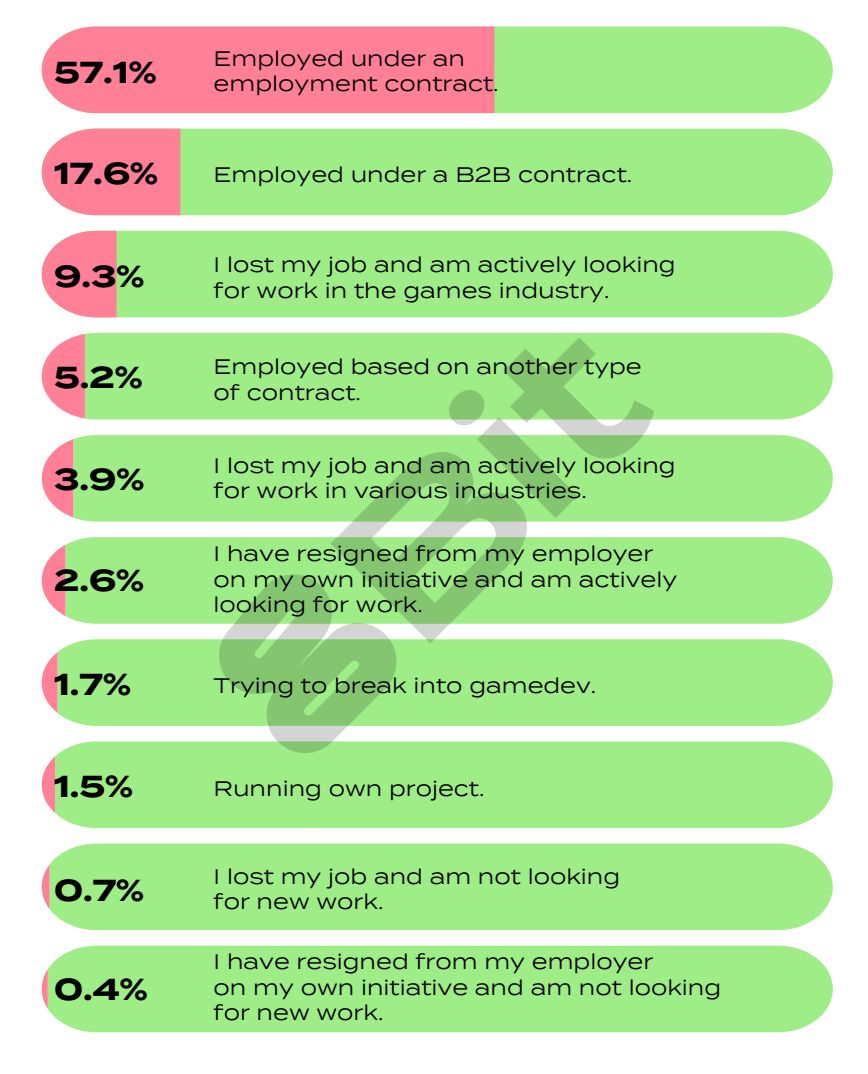
On a global scale (spanning major hubs across Europe and North America) traditional employment remains the anchor of the industry. As seen in the graphic from our report, a clear majority of 57.1% of industry professionals are employed under a standard employment contract. This is contrasted by 17.6% who operate globally via B2B arrangements, while the remainder of the ecosystem is split between alternative contract types (5.2%), those actively running their own projects (1.5%), and a segment currently navigating job losses and actively searching for work within or outside of games.
Central and Eastern Europe (CEE) heavily dominates the commercial contract landscape, with 51% of all game development professionals in the region operating under a Business-to-Business (B2B) structure.
Example: in Poland, which stands as one of the most intense and rapidly growing game development markets in the CEE region, the widespread adoption of B2B setups relies on a strict legal distinction. For a contract to remain valid as a commercial partnership rather than hidden employment, the developer must function as a legitimate, independent entity. Under Polish labor laws, if a B2B contractor is subject to direct corporate supervision, has fixed working hours mandated by the studio, or is treated identically to a standard employee, the relationship faces severe reclassification risks by local authorities. To stay compliant while enjoying the tax efficiencies of a sole proprietorship, Polish developers must maintain high operational autonomy, ensuring they are evaluated on their final milestone deliverables rather than treated as integrated, regular office staff.
Western Europe and Northern Europe (the Nordics) favor employment stability. Permanent contract structures represent the vast majority of the workforce in gamedev these zones, most likely driven by a cultural preference for comprehensive social safety nets, healthcare benefits, and strong labor protections.
It varies wildly by region. In Central and Eastern Europe, B2B contractors function more like dedicated, long-term partners, with 83% working exclusively for a single game studio full-time. True multi-client freelancing is much more common in Western Europe, where developers routinely split their time among several different studios.
Respondents who declared being employed at the time of completing the survey (79.9% of all respondents globally) were additionally asked about the type of contract they work under.
The question asked was: What does your employment situation look like at the moment of filling out this survey?
You may see the results below:
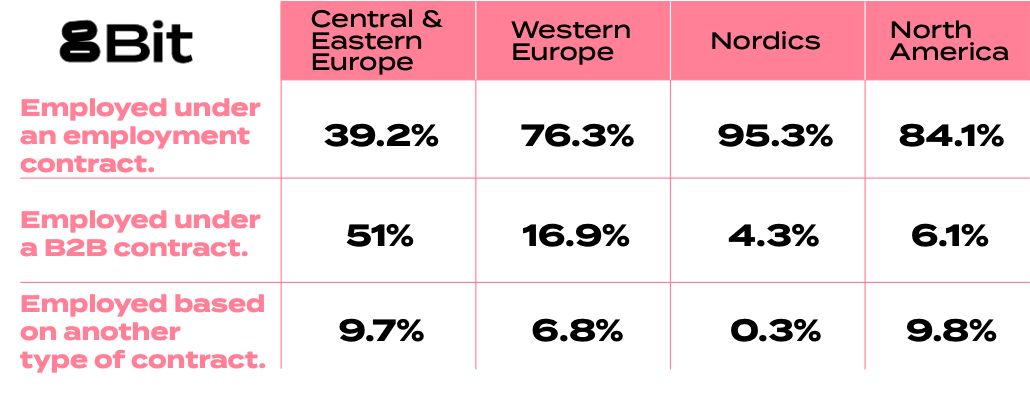
The data reveals that Europe is divided into distinct employment subcultures.
The table below breaks down the operational differences across these territories, mapping out how contractors distribute their clients:
| Workforce & Contractor Metric | Central & Eastern Europe (CEE) | Western Europe | Northern Europe (The Nordics)* |
|---|---|---|---|
| Primary Regional Contract Setup | B2B Sole Proprietorship (51% of market) | Permanent Employment Contract (Dominant Model) | Permanent Employment Contract (High Security Preference) |
| Single-Client Full-Time Contractor Share | 83% work exclusively for one game studio full-time. | 67% work exclusively for one game studio full-time. | 57% provide full-time services to just one client*. |
| Multi-Client Gamedev Contractor Share (2–3 Clients) | Only 10% split their part-time focus between 2–3 game clients. | 18% manage 2–3 clients in the games industry. | 43% actively maintain a multi-client gamedev portfolio*. |
| Primary Driver for B2B Model | Maximize net take-home pay and reduce corporate overhead. | Access to regional health coverage, parental leave, and strict labor protections. | Strong cultural focus on job security, institutional safety nets, and union baselines. |
*Note: Northern European insights are based on a smaller statistical sample size within the report. While we want to present the available data transparently, we recommend gathering additional B2B quota signals before treating Nordics contractor patterns as fully representative.
The data highlights a fascinating psychological and economic divide across the continent. In Central and Eastern Europe, the B2B structure is rarely used for short-term gigs; instead, 83% of contractors act as dedicated, full-time teammates for a single studio.
Moving westward and northward, a more traditional freelance model begins to emerge. However, for the segment of the European workforce that does manage multiple clients simultaneously, the 2026 Gamedev Salary Pulse data surfaces an operational pattern: the time-allocation.
The question asked was: Working for more than one client, how do you manage your time?
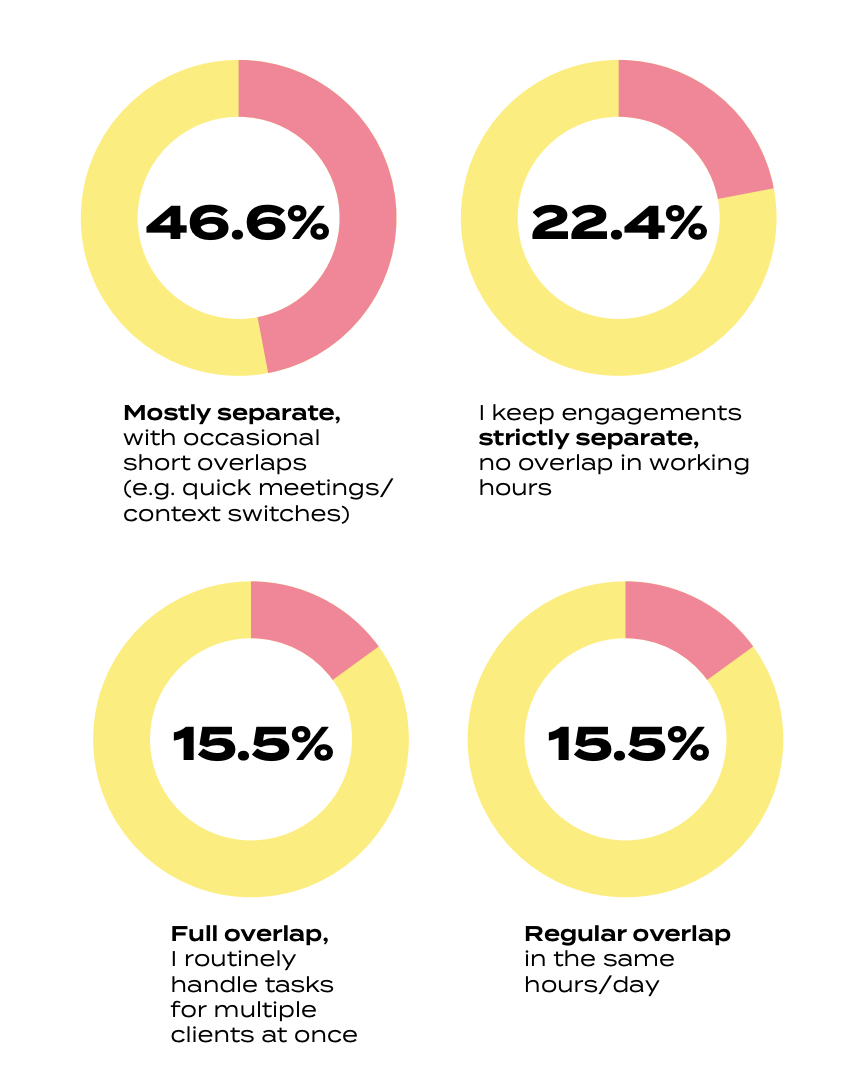
Across all regions, one-third of multi-client gamedevs admit to regular or full hour overlap.
In practice, that means some people may be context-switching between Studio A and Studio B within the same day. That doesn’t automatically mean bad intent, it just reflects how freelancers balance commitments.
Studios don’t need to overreact, but they do need a clean operating setup: clear outcomes, sensible checkpoints, and explicit boundaries around IP and confidentiality. Done well, this protects the project and keeps the collaboration professional.
With macroeconomic pressure still reshaping the games industry, including workforce reductions (34.5%) and ongoing streamlining (26.1%), where you hire and how you hire has become a real strategic lever, not a tactical detail.
Leaning into CEE can help studios scale quickly, especially when flexible B2B pipelines are part of the local norm. There’s also a human reality behind the numbers: when 83% of contractors rely on one studio as their sole client, the relationship becomes less “vendor-like” and more long-term in practice (still, B2B contracts need to stay in line with the local regulations). That makes clarity and consistency essential, with strong project communication, predictable delivery expectations, and fair treatment aren’t “nice-to-haves,” they’re retention drivers.
Hiring in Western Europe and the Nordics often means building teams with a stronger preference for stability. In practice, that usually comes with more permanent employment structures, plus the responsibility to do benefits and local compliance properly. The upside is loyalty and continuity. The trade-off is that you’re committing to payroll architecture and country-specific rules from day one.
8Bit is a global recruitment partner with deep roots across the European game development landscape. As such, our team is uniquely positioned to help your studio navigate these regional complexities.
Whether you are looking to scale your engineering team in Poland, secure a technical director in Germany, or find a specialized designer in Sweden, we look past one-size-fits-all templates to help you build a secure, compliant pipeline.
We are always eager to discuss your specific hiring needs, break down localized employment contexts, and design the most efficient, data-backed talent strategy for your studio’s long-term success.